


|
Podcast

|
Maturity
Encouragement
Good News
Church
Communion
Prayer
Christian Symbols
Scholarly Articles
Miscellany

|
Easter
Thanksgiving
Pentecost
Stations of the Cross

|
New Testament
Gospels
Acts
Paul's Letters
General Letters
Revelation
Topical Studies

|
Bible Studies
Articles
Books
Podcasts
Search
Menu
Donate
About Us
FAQ
Contact Us
Site Map

Will the Real St. Patrick
Please Stand Up?
by Dr. Ralph F. Wilson
Free
E-mail Bible Study
 Names and Titles of God
Home | Bible Studies | Articles | Books | Podcasts | Search | Menu | Donate | About Us | FAQ | Contact Us
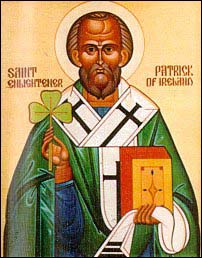 Terrified the Irish raiders would spot him, the youth hid at wood's
edge as he watched eager flames consume his family's house. Suddenly
powerful hands jerked his arms behind him. Coarse ropes burned
his wrists. He and dozens of others were herded to boats grounded
in the cove. He was now a slave.
Terrified the Irish raiders would spot him, the youth hid at wood's
edge as he watched eager flames consume his family's house. Suddenly
powerful hands jerked his arms behind him. Coarse ropes burned
his wrists. He and dozens of others were herded to boats grounded
in the cove. He was now a slave.
The sixteen-year-old watched his whole way of life slip away as the rhythmic oarbeats pushed the boats steadily west. A British nobleman's son, he'd had it easy enough. He hadn't cared much for school, preferring to go off with his friends. Christianity didn't mean much to him either. His father was a deacon in the village church, but Pat knew he held that office more for tax advantage than out of love for God.
The sound of pebbles crunching beneath the hull signaled their arrival. Yanked from the boat, he was thrust into a guarded pen to await sale.
From Slavery to Salvation
Young Patrick was finally bought by Miliucc, one of the pagan chieftain-kings. For the trip to the king's lands, the lad was assigned to a short-tempered soldier who would shout strange words, angry that Pat didn't understand. Not until they reached a crude stone barn and thatched hut did the man untie him.
The gruff king's herdsman who took charge of him didn't hesitate to curb the boy's lazy ways with a stout cudgel. Pat's job was to care for a large flock of sheep belonging to the king. Night and day he spent out on the mountain pastures. At least the sheep became his friends. Talking to them somehow soothed his heartache.
He also began to talk to the God his Christian grandfather had told him about. The despair of slavery and solitude of the mountain compelled him to reach out. "Our Father, which art in heaven," he began hesitantly, "hallowed be Thy name. . . ." The words recited in childhood now became a cherished prayer.
Later, in his short Confession, he described it this way: "Many times a day I prayed. The love of God and His fear came to me more and more, and my faith was strengthened. In a single day I would say as many as a hundred prayers, and almost as many in the night. I used to get up for prayer before daylight whatever the weather--snow, frost, rain-- without suffering any ill effects. The spirit within me was fervent."
Six long years of servitude on that rain-swept mountain forged the boy into God's man. Then one night he heard a voice: "Soon you will go to your own country." God was speaking. The voice came again. "See, your ship is ready."
That night he fled. Assured God was leading him, Pat plunged through the bogs and scaled the mountains which separated him from the sea, avoiding roads lest he be discovered.
After a 200-mile trek he saw the ship, making ready to sail. Finding the captain, he requested passage. His family would repay the fare, Pat promised. The surly captain refused. As Pat slowly retraced his steps along the beach, he prayed again. "You led me to this ship, O Lord. I know you won't fail me now." Suddenly he heard the whish of feet sprinting in the sand behind him. "Young man," a sailor called. "The captain says we'll take you after all. But hurry! The tide is in." God had heard.
The voyage took three days, but when they landed-- probably on the coast of France--they saw no people, only a desolate wilderness. For almost a month they sought food. The pagan captain who had mocked Pat's faith finally sought him out. "You say your God is great and all-powerful? Then pray for us." Pat was bold. "Be truly converted with all your heart to the Lord my God," he answered. "Nothing is impossible for Him." Suddenly a herd of pigs scrambled across the road. The hungry seamen were faster. Food at last! Within a few days they also came upon civilization.
Before returning home, Patrick sought out the famous French bishop, Germanus of Auxerre. Here the young man he developed a lifelong love for the Scriptures which Patrick came to know so well.
When he finally reached home in Britain, "my people received me as their son," Patrick recalled, "and sincerely begged me not to leave them." But it was not to be. Late one night he beheld a vision that changed his life: "I saw a man named Victoricus, coming from Ireland with countless letters. He gave me one of them, and I read the opening words which were: 'The voice of the Irish . . .' I thought at the same moment I heard their voice: 'We beg you, young man, come and walk among us once more.'" He must return to Ireland.
Confronting the Dark Powers
When Patrick began his mission about 430 A.D., Ireland was gripped by paganism. Druid priests performed human and animal sacrifices to appease the local gods. They practiced spiritism and black magic through incantations and occult rituals. Idolatry prevailed. The Irish knew nothing of Jesus.
Patrick decided to go first to the pagan king who had enslaved him as a youth. He would buy his freedom and tell him of Jesus. But when old Miliucc heard that Patrick was coming to convert him, he gathered all his goods around him and set fire to his house as a great funeral pyre. He would die with honor in the ancient way rather than subject himself to his slave's religion. Patrick, arriving as smoke still rose from smoldering ruins, was shattered. The first Irish convert he sought had committed suicide. "Why," cried Patrick to his companions, "would this king consign himself to the flames to avoid believing at the end of his life? Only God knows."
For the demonic power over this land to be broken, a greater power must prevail. Satan had won the first round, but Patrick would challenge him at his stronghold --Tara-- seat of the high king
Loegaire and his two evil druid priests, Lochru and Lucetmael. Tara was filled with many local kings, generals, nobility, and druids who were attending the pagan feast of Beltine which coincided with Easter that year. Patrick encamped in full view of the castle to celebrate the Resurrection of his Christ.
On the eve of the pagan festival it was the custom, upon penalty of death, that the high king should light the first bonfire before any others in the land. Patrick, however, had kindled a great fire which gleamed through the darkness to the inhabitants of the plain as well as all those gathered in the hilltop castle.
"Sacrilege!" cried Loegaire. "Let him be put to death!" But the druids pronounced a foreboding word: "O king, live forever. This fire will never be put out unless it is put out this night on which it has been lit. He who lit the fire and the coming kingdom by which it was lit will overcome us all." "Not so!" shouted the king. He yoked twenty-seven chariots for the druids, kings, and other guests, and drove for Patrick's fire.
The missionary was summoned before the king. Only one man rose to honor Patrick; the rest sat in stony silence. The confrontation which followed is as amazing as Elijah's victory over the prophets of Baal.
 Aerial view of the hill of Tara, where the high kings of Ireland reigned. |
The druid Lochru started to insult Patrick viciously and to slander the Christian faith in the most arrogant terms. A holy boldness took hold of Patrick. His eyes locked with the pagan priest's as truth confronted darkness. Sensing God's presence he shouted: "O Lord, who can do all things, who sent me here: May this wicked man who blasphemes Your name be carried up out of here and die straightway!" An unseen Power suddenly flipped the evil priest into the air and crashed him to the ground, his skull shattering against a rock. "Seize him!" the enraged king sputtered. Patrick stood and called, "May God arise and His enemies be scattered!" Darkness suddenly fell on the camp. Confused guards began to attack one another. The ground shook and frightened horses galloped off, smashing the chariots. A terrified king knelt before Patrick, though his eyes still flashed in anger.
Easter morning Patrick and his five companions marched into the castle and entered the king's banquet hall. A contest with the remaining druid, Luctmael, ended in the magician's fiery death. Patrick faced King Loegaire boldly. "Unless you believe now, you will soon die, for God's wrath will come down upon your head." That day a broken king knelt before God's servant.
This confrontation between Patrick's God and demonic forces marked the beginning of a thirty-year mission to Ireland. Danger and hardship remained his constant companions. Many sought his life. Twice he was imprisoned by his enemies--once for two full months. Intimidated? Not Patrick. "Daily I expect murder, fraud, or captivity," he wrote, "but I fear none of these things because of the promises of heaven. I have cast myself into the hands of God Almighty who rules everywhere."
The victory at Tara earned Patrick a reputation. Yet Ireland, dotted with scores of tiny, warring kingdoms, must be won step by step. Approaching a royal castle, Patrick would offer presents of money and fine gifts to secure an audience with the local king. Then he would tell the king and his family the wonderful news of Jesus' salvation from sin, His death on the cross, His resurrection from the dead. If the king gave his blessing, Patrick was free to preach throughout the realm. Despite fierce opposition from the druids, castle after castle became an outpost of the kingdom of God.
There was something about Patrick's exuberant faith and steadfast character that attracted these warlike kings. Once he asked Daire, king of Armagh, for a hilltop site on which to build a church. The man offered a spot on lower ground instead. Undaunted, Patrick began to build. One day Daire sent him a valuable three gallon bronze pot, imported from the Continent. "Thanks be to God," the missionary said. Daire raged when he heard of Patrick's response. "Stupid man! Doesn't he have any more grateful words for my gift than 'Thanks be to God'?" He sent his servants to demand the pot's return. "Thanks be to God, take it away," was all Patrick would say. Daire was so astonished by the missionary's humble reply that he came to the construction site himself. "This place isn't good enough for your church, Holy Man. You wanted the Ridge of the Willows? I give it to you and to your God."
Thirty years he tramped the roads and forded the rivers of that green land to see men and women "reborn in God" and come to know the Christ he loved so much. "We ought to fish well and diligently, as our Lord exhorts," he wrote. "Hence, we spread our nets so that a great multitude and throng might be caught for God."
By the time of his death he had baptized tens of thousands and established hundreds of churches throughout Ireland. Within a century this once pagan land became predominately Christian, possessing such a vigorous faith that Ireland in turn sent out missionaries to Scotland, England, France, Germany, and Belgium.
As an old man, Patrick looked back in awe.
"Those who never had a knowledge of God but worshipped idols and things impure, have now become a people of the Lord, sons of God."
The old saint died in his beloved Ireland, March 17th, about 460 A.D. The land which once enslaved him, he had set free.
Notes to the Editor
- Most of the incidents were taken from Patrick's Confession, written when he was an old man. Other events are from Muirchu's seventh century Life of Patrick. These early sources and an historical introduction may be found in A. B. E. Hood (editor and translator), St. Patrick: His Writings and Muirchu's Life (History from the Sources series; Chichester: Phillimore and Co., Ltd., 1978). I have avoided the many spurious legends which grew up around Patrick's memory over the centuries.
More on St. Patrick's Life, Prayers, and Legacy
Copyright © 2026, Ralph F. Wilson. <pastor joyfulheart.com> All rights reserved. A single copy of this article is free. Do not put this on a website. See legal, copyright, and reprint information.
 To be notified about future articles, stories, and Bible studies, why don't you subscribe to our free newsletter, The Joyful Heart, by placing your e-mail address in the box below. We respect your