


|
Podcast

|
Maturity
Encouragement
Good News
Church
Communion
Prayer
Christian Symbols
Scholarly Articles
Miscellany

|
Easter
Thanksgiving
Pentecost
Stations of the Cross

|
New Testament
Gospels
Acts
Paul's Letters
General Letters
Revelation
Topical Studies

|
Bible Studies
Articles
Books
Podcasts
Search
Menu
Donate
About Us
FAQ
Contact Us
Site Map

Amazing Grace,
The story of John Newton, author of America's favorite hymn
by Dr. Ralph F. Wilson
Free
E-mail Bible Study
 Names and Titles of God
Home | Bible Studies | Articles | Books | Podcasts | Search | Menu | Donate | About Us | FAQ | Contact Us
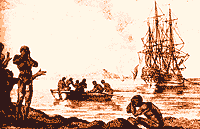
A slaveship anchored off the African coast. (Bibliothèque nationale, Paris) from Bronz, et. al, The Challenge of America (Holt, Rinehart and Winston, 1968), p. 155) |
But the author was a wretch, a moral pariah. While a new believer around 1750, John Newton had commanded an English slave ship.
You know what that meant. Ships would make the first leg of their voyage from England nearly empty until they would anchor off the African coast. There tribal chiefs would deliver to the Europeans stockades full of men and women, captured in raids and wars against other tribes. Buyers would select the finest specimens, which would be bartered for weapons, ammunition, metal, liquor, trinkets, and cloth. Then the captives would be loaded aboard, packed for sailing. They were chained below decks to prevent suicides, laid side by side to save space, row after row, one after another, until the vessel was laden with as many as 600 units of human cargo.
 Slaves were "packed" in ships for the voyage across the Atlantic. (The Granger Collection) in Peter Wood, The Seafarers: The Spanish Main (Time-Life Books, 1979), p. 63) |
At sea by the age of eleven, he was forced to enlist on a British man-of-war seven years later. Recaptured after desertion, the disgraced sailor was exchanged to the crew of a slave ship bound for Africa.
It was a book he found on board--Thomas à Kempis' Imitation of Christ--which sowed the seeds of his conversion. When a ship nearly foundered in a storm, he gave his life to Christ. Later he was promoted to captain of a slave ship. Commanding a slave vessel seems like a strange place to find a new Christian. But at last the inhuman aspects of the business began to pall on him, and he left the sea for good.
While working as a tide surveyor he studied for the ministry, and for the last 43 years of his life preached the gospel in Olney and London. At 82, Newton said, "My memory is nearly gone, but I remember two things, that I am a great sinner, and that Christ is a great Saviour." No wonder he understood so well grace--the completely undeserved mercy and favor of God.
Newton's tombstone reads, "John Newton, Clerk, once an infidel and libertine, a servant of slaves in Africa, was, by the rich mercy of our Lord and Saviour Jesus Christ, preserved, restored, pardoned, and appointed to preach the faith he had long labored to destroy." But a far greater testimony outlives Newton in the most famous of the hundreds of hymns he wrote:
Amazing grace, how sweet the sound
That saved a wretch like me,
I once was lost, but now am found,
Was blind, but now I see.'Twas grace that taught my heart to fear,
And grace my fears relieved.
How precious did that grace appear
The hour I first believed.Through many dangers, toils and snares,
I have already come.
'Tis grace hath brought me safe thus far,
And grace will lead me home.
For more on John Newton, see information included in the huge Cyber Hymnal (www.cyberhymnal.org). See also Christian History & Biography, Issue 81, Winter 2004, that focuses on John Newton's life. In particular see: "The Amazingly Graced Life of John Newton," by Chris Armstrong and "Timeline: The Life and Times of John Newton 1725-1807."
Copyright © 2026, Ralph F. Wilson. <pastor joyfulheart.com> All rights reserved. A single copy of this article is free. Do not put this on a website. See legal, copyright, and reprint information.
 To be notified about future articles, stories, and Bible studies, why don't you subscribe to our free newsletter, The Joyful Heart, by placing your e-mail address in the box below. We respect your