


|
Podcast

|
Maturity
Encouragement
Good News
Church
Communion
Prayer
Christian Symbols
Scholarly Articles
Miscellany

|
Easter
Thanksgiving
Pentecost
Stations of the Cross

|
New Testament
Gospels
Acts
Paul's Letters
General Letters
Revelation
Topical Studies

|
Bible Studies
Articles
Books
Podcasts
Search
Menu
Donate
About Us
FAQ
Contact Us
Site Map


Squanto--God's Special Indian
a Thanksgiving Story
by Dr. Ralph F. Wilson
Free
E-mail Bible Study
 Names and Titles of God
Home | Bible Studies | Articles | Books | Podcasts | Search | Menu | Donate | About Us | FAQ | Contact Us
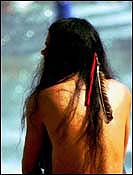 Sailors poured onto the rocky beach as their small craft landed.
Nearby cliffs echoed with a shout: "Grab that short one
before he gets away!" The Indian boy felt a sailor's callused
hands grasp his shoulders. Though he thrashed and jerked, Squanto
(SKWAN- to) couldn't break free. As fibers from a coarse rope
cut into his wrists he finally decided that struggle was useless.
He was dragged into a longboat, then carried aboard a three-masted
English ship anchored offshore.
Sailors poured onto the rocky beach as their small craft landed.
Nearby cliffs echoed with a shout: "Grab that short one
before he gets away!" The Indian boy felt a sailor's callused
hands grasp his shoulders. Though he thrashed and jerked, Squanto
(SKWAN- to) couldn't break free. As fibers from a coarse rope
cut into his wrists he finally decided that struggle was useless.
He was dragged into a longboat, then carried aboard a three-masted
English ship anchored offshore.
Squanto had been fishing along the rugged coast when his friend had looked up and pointed, "Great boats with white wings." They had scrambled over the boulders to meet the strange white-faced intruders. Now Squanto was their captive.
Weeks later, a pale Squanto wobbled down the gangplank from that lurching deck onto firm land. He and other Indians were taken to the elaborate mansion of Sir Ferdinando Gorges who had financed many expeditions to the New World. For the next three years, the Indian youths were taught English. At first Squanto found the new tongue awkward, but eventually he surprised himself: "My name is Squanto. I have come from America."
His English host was eager for the Indians to master the language. One day Gorges called them to his quarters. "Young braves, you have studied hard. Now you will be sent as guides on new explorations of America. I will miss you."
"Another ship? How can I stand that constantly rolling deck?" Squanto thought. But in time he gained his sea legs. His knowledge of the rivers and natural harbors, of the tribes and chieftains of his homeland proved very helpful to the English explorers.
For years he had longed to see his beloved bay and village again. One day, as his ship sailed along the New England coast, he spotted it. Squanto ran to the captain. "May I go ashore, sir? That's my village. That's my home!"
"Yes, young man. You have served us well. Now you can return to your people."
As soon as he heard the pebbles crunch under the longboat's hull, Squanto jumped out and ran to embrace his parents. He was home!
But his homecoming didn't last long. Within weeks Squanto spotted new sails on the horizon. No longer afraid of English ships, he proudly led a band of young braves to greet the sailors. Armed seamen seized Squanto and nineteen other Patuxet (paw-TUX-et) Indians.
Once again he was imprisoned aboard a British merchant ship. Rats scampered across the damp hold where the Indians were chained. Scarce provisions, a stormy trip, and continual seasickness took their toll. Several Indians were buried at sea. By the time they reached the Spanish slave-port of Malaga (MA-la-ga), Squanto was very weak.
One by one the surviving braves were pushed up onto the auction block to be sold. Finally it was Squanto's turn. He could barely stand. "Senores (sen-YOR-es), what will you bid for this strong Indian?" the slave trader rasped. A brown-robed monk nodded and the auctioneer grinned. "Sold to the brothers of the monastery."
A heavy pouch of coins exchanged hands and the monk led Squanto home. At last his wrists were untied. A friar brought fresh water and plenty of food, though Squanto could only eat a little.
"Estas libre (es-TAS LEE-bray)! You are free." Squanto looked into the clear eyes of this man of God. Though he knew no Spanish, he understood. Over the next few weeks he pieced it together. Their love for Jesus had prompted these Christian brothers to buy Indian slaves and teach them the Christian faith. As the monks nursed him back to health, Squanto began to love this Jesus, too.
Yet he longed for home. The Indian used his command of English to find a fishing boat headed for London, where he rejoined his explorer friends. Again, Squanto became a guide for explorations of the New World. Years passed. The day finally came when he saw the familiar coastlands of home. Once more he was granted permission to go ashore.
No one greeted Squanto at the beach. He ran to his village. The bark-covered round-houses were empty. Not even a dog barked. Graves outside the village told the story. Samoset (SAM-o-set), his friend from a neighboring tribe, could bring little comfort. "A whiteman's sickness struck your people. One week, all dead. Many villages lie silent like Patuxet."
Squanto's emptiness overwhelmed him. Parents, brothers, sisters, forever gone. He wandered the forests for weeks in his grief. Finally he went to live with his friend Samoset.
One cold December morning, six months after he returned, Squanto watched the white sails of a ship grow on the stormy horizon. This time he hid as the men came ashore. Their clothes looked different from those worn by sailors and the fancy English officers he had seen on other ships. Broad hats and great black capes shielded them from the biting wind. He could glimpse white caps and long dresses of women aboard the ship anchored in the bay. Often he saw children playing on deck. As green leaves came to clothe barren trees, the settlers began to build houses on the very place where his village had stood. Day after day Squanto watched intently, never seen.
Samoset urged him to meet these settlers. A cry went up as the Indians strode into the settlement. Men grabbed for their muskets.
The Indians lifted their hands in greeting. "My name is Squanto. This is Samoset. We come in peace." The settlers were astounded. An Indian who spoke clear English? The Pilgrims lowered their muskets and invited the Indians to share their meager food.
The sun had set by the time Samoset got up to leave, but Squanto hesitated. Many of the settlers had already died from disease and winter's bitter cold. There was little food. Yet they weren't giving up. He thought of his old village's battle with death. "You go," Squanto told his friend in their Indian tongue, "I'm staying. This is my home, my village. These will be my new people."
Squanto turned to the leaders. "May I stay with you? I can help you. I know where you can find foods in the forest."
The white men studied the Indian carefully. Could he be trusted? Still, the struggling colony was in no position to refuse help. "Yes. Please stay."
That spring and summer Squanto proved his worth many times over. He led them to brooks alive with herring beginning their spring migration upstream. He showed the settlers how to fish with traps. He taught them where to stalk game in the forest. The children learned what berries they could pick for their families. Twenty acres of corn grew tall after Squanto showed the Pilgrims how to plant fish with the native corn seeds from a local tribe.
Once, a hostile tribe captured Squanto. "If he is killed," shouted their chief, "the English have lost their tongue." A small Pilgrim force arrived just in time, firing their muskets in the air. The terrified chief released his captive and fled. Squanto repaid the Pilgrims' favor. His bargaining skills kept neighboring tribes from attacking the small Plymouth colony.
In the fall the Pilgrims planned a feast to celebrate God's merciful help. Squanto was sent to invite friendly Chief Massasoit (MASS-a-soit) and his braves.
They gathered around tables spread with venison, roast duck and goose, turkeys, shellfish, bread, and vegetables, with woodland fruits and berries for dessert. Before they ate, the Pilgrim men removed their wide-brimmed hats and Indians stood reverently as the governor led them in solemn prayer.
"Thank You, great God, for the bounty You have supplied to us. Thank You for protecting us in hardship and meeting all our needs. . . ." Towards the end of the long prayer, Squanto was startled to hear his own name. "And thank You for bringing to us the Indian Squanto, your own special instrument to save us from hunger and help us to establish our colony in this new land." Squanto stood proudly. It was a day to remember.
Two years passed. Squanto lay mortally ill, struck by a raging fever while scouting east of Plymouth. He turned over in his mind the events of his strange life. It almost seemed that a plan had led him. The first time he was captured he learned English. The second time, he was freed by gentle Christians who taught him to trust in Jesus. And though his own people had died of sickness, God had sent him to a new people who built their colony where his old village once stood.
Pilgrim leader William Bradford knelt at his bedside. "Pray for me, Governor," the Indian whispered, "that I might go to the Englishmen's God in heaven." Squanto breathed his last November 1622, gone from the New World, but entering a heavenly one.
This account is based on historical facts found in primary sources
such as William Bradford's Journal, Capt. John Smith's The Generall
Historie of New England, and Sir Ferdinando Gorges' Brief Narration,
and numerous secondary sources.
The Rutgers University Graph for Estimating Readability places
this story at a level readable by 3rd and 4th graders. Vocabulary
was checked against words in Amy Brown, John Downing, and John
Sceats (eds.), Dictionary 4 (New York: Jove Books, 1974), graded
for 10-12 year-olds.
Copyright © 2026, Ralph F. Wilson. <pastor joyfulheart.com> All rights reserved. A single copy of this article is free. Do not put this on a website. See legal, copyright, and reprint information.
 To be notified about future articles, stories, and Bible studies, why don't you subscribe to our free newsletter, The Joyful Heart, by placing your e-mail address in the box below. We respect your