


|
Podcast

|
Maturity
Encouragement
Good News
Church
Communion
Prayer
Christian Symbols
Scholarly Articles
Miscellany

|
Easter
Thanksgiving
Pentecost
Stations of the Cross

|
New Testament
Gospels
Acts
Paul's Letters
General Letters
Revelation
Topical Studies

|
Bible Studies
Articles
Books
Podcasts
Search
Menu
Donate
About Us
FAQ
Contact Us
Site Map

Seek Righteousness, Seek Humility (Zephaniah 2:3)
by Dr. Ralph F. WilsonAudio (17:52)
Free
E-mail Bible Study
 Names and Titles of God
Home | Bible Studies | Articles | Books | Podcasts | Search | Menu | Donate | About Us | FAQ | Contact Us
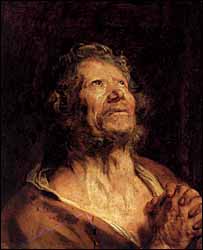 Anthony Van Dyck, 'An Apostle with Folded Hands' (1618-20), paper on oak wood, 23 x 18 in., Gemäldegalerie, Berlin. Larger image. |
Many of us live in a time of decline, of falling away from the Lord. The foulest acts are winked at, falsehoods are celebrated as truth, people flaunt laws with impunity.
The prophet Isaiah (active 740-681 BC) speaks about the gross moral corruption in his own day:
"Woe to those who call evil good
and good evil,
who put darkness for light
and light for darkness,
who put bitter for sweet
and sweet for bitter.
Woe to those who are wise in their own eyes
and clever in their own sight." (Isaiah 5:20-21, NIV)
Decades later, the situation among God's chosen people is worse.
Manasseh (696-642 BC) has reigned as king in Judah. For over half a century he actively promotes paganism in the land so that it has become pervasive. In the holy temple of Yahweh, Manasseh orders an image dedicated to Asherah, the goddess of fertility.1 In the sacred courts he builds an altar to worship the sun, moon, planets, and stars.2 Pagan altars to Baal and Asherah dot the hilltops. In addition, it is a time of gross injustice and government-sponsored bloodshed (2 Kings 21:1-16). The nation is corrupt from top to bottom.
Josiah is six when his evil grandfather Manasseh dies in 642 BC. Two years later, his father King Amon is assassinated. Abruptly, Josiah (reigning 640-609) is crowned king at the tender age of eight years. Fortunately, his heart is tender towards the Lord, and in his mid-twenties he begins to bring reform (2 Kings 22-23). During Josiah's reign, God raises up several prophets to help turn the nation back to Yahweh. One of these is Zephaniah (active 640-625 BC).
The Day of the Lord
Zephaniah declares that God will bring a terrible Day of Judgment upon Judah and the surrounding pagan nations for their idolatry and sin.
"The great day of the Lord is near,
near and hastening fast;
the sound of the day of the Lord is bitter;
the mighty man cries aloud there.
A day of wrath is that day,
a day of distress and anguish,
a day of ruin and devastation,
a day of darkness and gloom,
a day of clouds and thick darkness." (Zephaniah 1:14-15)
In the Scriptures, "the Day of the Lord" sometimes looks to an historical event -- Babylon destroys Jerusalem in 587 BC, Rome destroys Jerusalem in 70 AD. But ultimately, these judgments point forward as types of the final Day of the Lord when Messiah returns and judges the nations. For believers, this coming of Christ is a fearsome event capped with resurrection and joy.3 But for the complacent, the nominal believer, the unrepentant, it is something else altogether. It portends a Day of Judgment before the throne of God when the books are opened, they are found guilty, and cast eternally into the lake of fire.4 Sobering to contemplate!
Overview
With that background, I want to look carefully at a single verse from Zephaniah. It was brought to mind by John Willison's praise chorus "Seek Righteousness" based on this passage.5 Zephaniah declares:
"Seek the LORD, all you humble of the land,
you who do what he commands.
Seek righteousness, seek humility;
perhaps you will be sheltered
on the day of the LORD's anger." (Zephaniah 2:3)
The prophet issues a command: "Seek the Lord." The object of this command is, curiously, not the sinners, whose course is already set, but the believers, the obedient, the "humble of the land." Three times the hearers are commanded to seek -- (1) seek Yahweh himself, (2) seek righteousness, and (3) seek humility -- with the hope that on the Day of the Lord, they will be "sheltered" or "hidden"6 from Yahweh's coming wrath for the sins of his people and of the nations.
Shelter on the Day of the Lord
"... Seek righteousness, seek humility;
perhaps you will be sheltered (sātar)
on the day of the LORD's anger." (Zephaniah 2:3)
The Psalms, especially, speak of God's shelter, describing it with the noun sēter, "hiding place," from sātar, "hide, conceal,"7 sometimes translated "refuge," "secret place," or "shelter."8 It is clear that God is our hiding place.
"You are my hiding place (sēter);
you will protect me from trouble
and surround me with songs of deliverance." (Psalm 32:7, NIV)
"You are my hiding place
(sēter) and my shield;
I hope in your word." (Psalm 119:114, ESV)
"He who dwells in the shelter (sēter)
of the Most High
will abide in the shadow of the Almighty." (Psalm 91:1-2, ESV)
In our passage, the Hebrew includes a word of uncertainty -- "perhaps you will be sheltered...." The word is variously translated "perhaps," "it may be," or "maybe."9 Some say it represents the uncertainty of Judah's response to God's appeal, but it is likely an expression of hope that "safeguards God's sovereign freedom" in salvation.10
When you read the Book of Revelation, you get a feeling for the foreboding intensity of God's wrath upon sin as the terrible consequence of his judgments on the Day of the Lord roll on and on to reach their full measure. I think of an awesome passage in Revelation.
"Then the kings of the earth, the princes, the generals, the rich, the mighty, and every slave and every free man hid in caves and among the rocks of the mountains. They called to the mountains and the rocks, 'Fall on us and hide us from the face of him who sits on the throne and from the wrath of the Lamb! For the great day of their wrath has come, and who can stand?'" (Revelation 6:15-17)
The sinners would rather be crushed by rocks, than face God's terrible wrath on Judgment Day.
Our shelter, however, is Jesus the crucified and resurrected Lamb of God, who stands before the great white throne as the books are read and judgment is passed. It is his "Lamb's book of life" that is opened and counters the penalty for the sins for those whose names are inscribed therein (Revelation 20:12-15; 21:27).
The Day of the Lord will be a terrible time. Some contend that true believers will be raptured prior to the Day of the Lord and thus avoid all the pain and struggle,11 but Jesus taught his disciples at some length to be prepared to be faithful to the Lord through this time of great tribulation (Matthew 24-25). We too must prepare ourselves according to Jesus' command:
"Stay awake at all times, praying that you may have strength to escape all these things that are going to take place, and to stand before the Son of Man." (Luke 21:36)12
Zephaniah pleads, no, he commands:
"... Seek righteousness, seek humility;
perhaps you will be sheltered
on the day of the LORD's anger." (Zephaniah 2:3)
Seeking
In light of the coming Day of the Lord, the core command of Zephaniah 2:3 is to seek. The word, repeated three times in this verse, is bāqash, which can be used in the sense of (1) "seek" to find, "look for" an object, (2) "seek to obtain," try to get, and (3) seek someone's presence.13
Our verse tells us to seek three things:
- "Seek (the presence of) the LORD"
- "Seek (to obtain) righteousness."
- "Seek (to obtain) humility."
The first of these, seeking God, or seeking God's face, I've explored at some length elsewhere.14 Here, I'm particularly interested to examine this seeking of righteousness and humility. What are they? How do we do we seek them? Just what does that seeking entail?
Seek Righteousness
A century previous to Zephaniah, the prophet Amos (active 760-755 BC) calls out Judah's sins. The prophet declares that true righteousness involves:
- Speaking truth without falsehood,
- Treating the poor and powerless fairly in the legal system,
- Generosity towards the poor,
- Freedom for the righteous to live without oppression,
- Refusal to take money to pervert justice and honest government,
- Loving good and hating evil (Amos 5:10-15).
A show of practicing religion at the same time as you are practicing evil is disgusting to God (Amos 5:21-27). Rather than the empty boasts of secular pride, Amos demands:
"Seek out Yahweh and you will survive
or else he will sweep like fire...." (Amos 5:6)
Amos calls for justice and righteousness.
"Let justice roll down like waters,
and righteousness like an ever-flowing stream." (Amos 5:24)
These words, justice and righteousness, are synonyms that often occur together.
- "Justice" is the noun mishpāṭ, which involves good governing. Rightness is rooted in God's character and ought to be an attribute of man in general and of judicial process as well as correct civil administration that favors all, not just the wealthy and influential.15
- "Righteousness" is the noun ṣedeq, "justice, righteousness." The root basically connotes conformity to an ethical or moral standard.16 "
One stresses righteousness in governing, the other personal uprightness, though they often overlap.
Seeking righteousness must include seeking the Righteous One, whose character is the sole standard by which true righteousness is determined. In the Sermon on the Mount, Jesus teaches his disciples not to be distracted with the quest for material things. Rather:
"Seek first his kingdom and his righteousness,
and
all these things will be given to you as well." (Matthew 6:33)
Seeking is active, not passive; urgent, not occasional.
Seeking righteousness isn't about condemning others' sins. It is about examining my own life and asking: Is the way I am acting or thinking pleasing to God? Is my standard of righteousness sloppy and permissive? Is it aligned with God's standards? Seeking righteousness means self-examination, repentance, and change.
Seek Humility
The third command to seek is to "seek humility."17 The Hebrew noun is ʿănāwâ, "humility," from the verb ʿānâ, with the root meaning, "to force," or "to try to force submission."18
We could look at humility as before people. But here, Zephaniah is talking about humility before God. One who is humble before God submits to God willingly without need for God's pressure to force him or her to submit.
There is something in our human spirit that seeks independence. It is normal for teenagers to seek independence from their parents; it is an essential part of growing up. But when we seek independence or separation from God, it is not natural growth but spiritual rebellion. This bent towards self-rule and independence from God causes us to resist God, to keep our distance from him so we won't hear what we don't want to hear, and to assert our own will over his. We might look at disobedience as a minor thing. But disobedience to God is deadly serious.
God gives King Saul (reigned 1050-1010 BC) a direct command which he disregards. Saul makes excuses, but the prophet Samuel (active 1050-1000 BC) rebukes Saul's disobedience in no uncertain terms:
"For rebellion is like the sin of divination,
and arrogance like the evil of idolatry." (1 Samuel 15:23a)
Rebellion is not witchcraft and idolatry, but rebellion against God is as serious as witchcraft and worshipping other gods. Don't excuse or pretend that your rebellion isn't serious.
Just after the new temple is dedicated, the Lord appears to Solomon (reigned 970-931 BC) at night and speaks to him of a time -- just such a time as Zephaniah lives in -- when his people will have fallen away from God. He promises Solomon:
"If my people, who are called by my name, will humble themselves and pray and seek my face and turn from their wicked ways, then will I hear from heaven and will forgive their sin and will heal their land." (2 Chronicles 7:14, NIV)
In that verse we see the same three elements (in a different order) that Zephaniah tells people to seek:
| Zephaniah 2:3 | 2 Chronicles 7:14 |
| "Seek the LORD" | "Seek my face" |
| "Seek righteousness" | "Turn from their wicked ways" |
| "Seek humility" | "Humble themselves" |
Have you been excusing yourself about something God has said to do or not do? Don't fool yourself. This is passive rebellion. Seek God's righteousness in your life. Seek humility before God, my friend, that you may be sheltered on that Day through the grace of our Lord Jesus Christ.
Zephaniah spoke his words to "the humble of the land." And so I speak these words to you. Before joy in the Lord comes repentance. And to this repentance God is calling you and me today.
Prayer
Father, you know us and love us. But sometimes there is deep within us a passive rebellion and an anger at You or anyone who would tell us what to do or not do. Please, please, help us see what is really in our hearts. Please touch the troubled waters of our soul. O Lord, we seek You. We seek Your righteousness. We long for humility before You in our inner being. Help make it so, O Lord. We trust in the grace of our Lord Jesus Christ to help us to repent, to turn our faces afresh toward Your light, and to bask with joy in Your presence. In Christ's holy name, we pray. Amen.
Discussion Question
What does seeking righteousness mean for me? What is God dealing with me about? In what ways might I be rebelling rather than being humble before God? When will I repent? What will change look like in my life?
End Notes
[1] K. G. Jung, "Asherah," ISBE 1:317.
[2] "Hosts of heaven" (ESV, NRSV, KJV), "starry hosts" (NIV) are the heavenly bodies, including the sun, moon, and stars. Israel is commanded never to worship them upon pain of death (Deuteronomy 4:19; 17:3).
[3] 2 Timothy 4:8; John 6:39; 2 Corinthians 1:14; Philippians 1:6, 10; Luke 12:8; 1 Corinthians 15:51-53; 1 Thessalonians 4:13-18; etc.
[4] Revelation 20:11-15; Romans 2:5-6, 16; Revelation 6:17; Jude 6; 2 Peter 3:12; Matthew 7:22; 10:15; 16:27; 24:30; 2 Peter 3:7; 1 Thessalonians 5:4; 1 Corinthians 3:13; etc.
[5] John Willison, "Seek Righteousness" (© 1992, Vineyard Worship/Integrity Music). You can listen to the song on YouTube as part of the album "Touched by the Father's Heart: Live Worship Songs of the Vineyard" (1992).
[6] "Sheltered" (NIV) or "hidden" (ESV, NRSV, cf. KJV) is the Niphal of sātar, "be hidden." The root idea is "to hide," with the thought of protection. R. D. Patterson, sātar, TWOT #1551; Holladay 260, Niphal 2.
[7] Sēter, TWOT #1551a.
[8] See my article, "Joy in the Secret Place" (Psalm 32:6-11), The Joyful Heart, 2 Sep 2021. https://www.jesuswalk.com/psalms/psalm32-hiding-place.htm
[9] The adverb ʾûlay, "perhaps, suppose" is an "expression of hope, entreaty, fear" (Holladay, 6; TWOT #46).
[10] Baker, Zephaniah, p. 104.
[11] Dispensationalism (including a "secret rapture" theory) has been circulating in evangelical circles for nearly two centuries, beginning with John Nelson Darby (1800-1882) and the Plymouth Brethren in the 1830s. It was popularized in the US in the early 20th century through the Scofield Reference Bible (1909) and the Bible School Movement. Later by Hal Lindsay's book, The Late Great Planet Earth (1970) and the Christian apocalyptic novel Left Behind (1995) by Tim LeHaye (1926-2016) and Jerry B. Jenkins (b. 1949), ultimately resulting in a series of 16 novels (1995-2007) and a series of films in the Left Behind series (2000, 2002, 2005, 2014). The theory is that Jesus will come secretly for believers, who will be raptured suddenly without notice before the tribulation (pre-trib). Then Christ will come publicly in his glory later on after the tribulation. In other words, two comings of Christ. The problem I have with it is that the Scripture doesn't teach a secret rapture or two comings. Both Jesus' Analogy of the Lightning (Luke 17:24; Matthew 24:27) and his Analogy of Vultures Gathering (Luke 17:37; Matthew 24:38) point to a sudden, visible coming of Christ. For more on this, see a popular-level discussion in Marvin Rosenthal, The Pre-Wrath Rapture of the Church (Nelson, 1990) and my study, The Book of Revelation: Discipleship Lessons (JesusWalk Publications, 2004, 2011), www.jesuswalk.com/revelation/ Also see my Discipleship Training in Luke's Gospel (JesusWalk Publications, 2010), Appendix 2G. Introduction to Eschatology. www.jesuswalk.com/luke/intro-to-eschatology.htm
[12] Also Matthew 24:42-44; 25:13; Mark 13:33, 37; cf. 1 Thessalonians 5:2-6; Revelation 16:15.
[13] Holladay 46, Piel meanings 1, 3, and 4. Coppes says, the root of the word is to seek to find someone or something you believe exists (Leonard J. Coppes, bāqash, TWOT #276).
[14] "Seek His Face Continually (Psalm 105:4)," The Joyful Heart, August 19, 2019; and "Seeking God Diligently (Isaiah 55:6-9)."
[15] Robert D. Culver, mishpāṭ, TWOT #2443c.
[16] Harold G. Stigers, ṣedeq, TWOT #1879a.
[17] For more on humility, see my study Humility: Disciple's Guide to a Humble Life (JesusWalk Publications, 2024, https://www.jesuswalk.com/humility/).
[18] Leonard J. Coppes, ʿānâ, TWOT #1652b.
Copyright © 2026, Ralph F. Wilson. <pastor joyfulheart.com> All rights reserved. A single copy of this article is free. Do not put this on a website. See legal, copyright, and reprint information.
 To be notified about future articles, stories, and Bible studies, why don't you subscribe to our free newsletter, The Joyful Heart, by placing your e-mail address in the box below. We respect your